MILAN, ITALY — Zach Werenski steps off the Milano Santagiulia ice and tugs at the foreign band of sweat-soaked fabric Velcro’d around his throat.
The Team USA defenceman is still getting used to wearing a neck guard. He must.
“This is light. It’s very easy,” explains Werenski, who was also forced into neck protection during the Americans’ run to gold at the 2025 world championship.
“At the worlds, I wore one of the shirts, and it was pretty hot. Like, I was sweating a lot more. But this has been super easy for me. I really don’t notice it too much. It’s really not bad at all.”
Cut-resistant neck protection is now a mandatory accessory at all International Ice Hockey Federation games, and it has added a new wrinkle for the veteran NHLers who are used to letting their collars breathe.
-

-
Keep up with Olympic men’s hockey
The men’s hockey tournament at Milano Cortina 2026 runs from Feb. 11-22. Follow along with all the scores and standings.

In previous Winter Games attended by NHLers, neck guards were optional.
The 2023 death of Adam Johnson — who died after defenceman Matt Petgrave’s skate blade cut Johnson’s neck during an Elite Ice Hockey League game in England — sparked change.
Nearly two months after Johnson’s death, the IIHF Council mandated the use of a neck laceration protector at all levels of IIHF competitions.
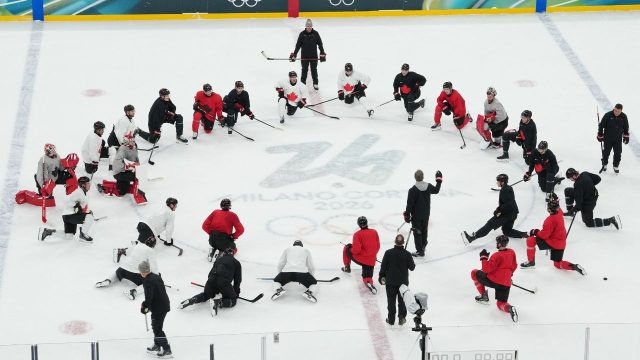
A few NHLers have resisted test-driving the various neck guards — loose straps, undershirts with extended collars — available to them while practising in Milan, but most are using the training sessions to get accustomed to their new accessories.
“I do not wear one in Vegas, no,” Jack Eichel says, after Team USA’s second skate. “So, it’s new for me. But it’s new for a lot of guys. You just try and find whatever’s most comfortable for you. Obviously, it’s part of the international play, so we’ll make it work.
“This is the first time I’ve worn mine. I forgot to wear one yesterday in practice. I really haven’t worn in quite a while. So just try and get used to what it feels like. But, honestly, it’s not, it’s not bad.
“I mean, you can feel it a little bit, right? I think you’re usually more free. But it’s not like a hindrance or anything.”
Not that bad is a common refrain from these pro athletes who are happy to adjust to jetlag and imperfect ice to realize their long-deferred Olympic dreams.
“I mean, I don’t think many guys love it,” U.S. captain Auston Matthews says. “But I think once you kinda get out there, you don’t notice it much.”
Players like Matthews and the Tkachuk brothers haven’t experimented adding neck protection while playing with their club teams, but most have added cut-resistant sleaves over their wrists and ankles into their repertoire.
Coincidentally, former U.S. Olympic shootout hero T.J. Oshie was at the forefront of the neck-guard movement at the pro level. Oshie’s Warroad performance brand has seen a spike in base layers and cut-resistant neck guards for players as adults began taking safety more seriously since Johnson’s death.
“When you see that, you think about your own kids,” Oshie told Sportico. “I have my own kids, and it makes you want to go out there and find whatever is available, and you want the best.”
Neck guards will be mandatory for first-time NHL players starting in the 2026-27 season, in accordance with the new collective bargaining agreement rules. However, the rule will be grandfathered in, much like face shields and helmets before that.
Anyone who has appeared in at least one NHL game before 2026-27 season won’t be subjected to the rule.
“I just haven’t worn one since youth hockey, and I know they’re implementing them here and in junior leagues and stuff like that,” Brady Tkachuk says. “Whatever those leagues feel is safe for their players, it’s up to those individual leagues. Yeah, I’m just not used to it. Being in the NHL, I’ve never worn it in forever. So, just gotta follow the rules.”
Tkachuk sounds like a guy who will be ditching the guard once he returns to Ottawa. He’s hasn’t considered wearing one in the NHL.
“I don’t know. I just try not to think about getting cut,” Tkachuk says. “But I have all the other cut-proof stuff, wrist and socks. I just haven’t tried it. I haven’t done it since youth hockey. I know a lot of guys who use it do like it, so I guess we’ll see what happens in our future.”
Werenski sounds more open to the idea.
“I’ve thought about. I won’t say I’m superstitious, but maybe a little bit,” Werenski says. “And I’ve never worn one (in the NHL), and I don’t like changing anything. I don’t like changing my equipment around.
“But maybe after this tournament, if I like it and I feel good with it, you never know.”