Unless something changes, Canada’s days as a winter-sport heavyweight may be numbered.
It’s hard to come up with any other conclusion after examining the performance of Team Canada at Milano Cortina 2026.
With core funding from the federal government not increasing since 2005, per CBC reporting, Canadian Olympic officials had warned for years that a downward turn in the medal standings could happen.
They were right.
Canada finished this Winter Olympics with 21 medals — its lowest total since 2002 in Salt Lake City when the country won 17 medals and swept hockey gold instead of a pair of silvers. Of those 21 medals, just five were gold.
The red and white placed eighth in the overall medal standings, Canada’s worst finish since 1992 in Albertville, France. Olympic-leading and far-smaller Norway, which introduces sports to kids with a much more inclusive model, nearly doubled Canada’s total with 41 medals this year.
-
-
Follow the medal race at Milano Cortina 2026
See how all the countries are doing in the overall standings at the Winter Olympics.

What’s more, about three-quarters of Canada’s medal winners are 30 or older.
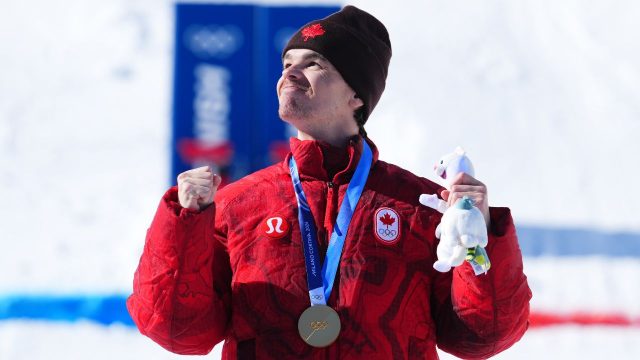
Curling skip Brad Jacobs, who led Canada to its fifth and final gold, is 40. Valérie Maltais, 35, and Ivanie Blondin, 35, two thirds of Canada’s back-to-back team pursuit speedskating champs, don’t figure to be back in 2030. Neither does all-time moguls great and 2026 gold and silver medallist Mikael Kingsbury, 33.
Canada’s other two gold-medal winners were 24-year-old freestyle skier Megan Oldham and 28-year-old short-track speedskater Steven Dubois, but there is not a clear, sizeable next-gen group for 2030.
“This is not the result, especially in the Winter Games, we aspire to have,” COC chief executive officer David Shoemaker said at a Games-ending press conference on Sunday. “We know we can do better. We demonstrated in the early 2000s that when we set our minds to something, we can achieve it and we can achieve it at a very high level.”
The COC’s message, in large part, was aimed at the federal government on Sunday.
This discussion always has been and always will be very political. There are all kinds of different takes on how many government dollars should be directed to athletes and sports in Canada’s national programs.
We all know it’s a challenged economy. Where does sport fit on the pecking order? Debate away.
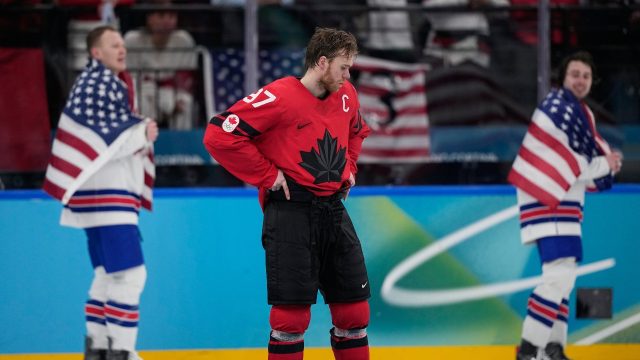
And let’s face it, many Canadians would feel very differently about these Olympics if the men’s or women’s hockey team scored in overtime of either gold-medal game instead of the Americans.
“There’s no question for the government this is about competing priorities,” Shoemaker said. “This is nation-building at its finest, at a very modest expense when you compare it to pipelines and icebreakers.”
The COC’s point is that few events produce more interest among the general population than the Olympics — no matter what you think of the IOC.
Many people who don’t watch sports regularly will not be shy about having hot takes on controversial curling rules or figure-skating judging. It’s common to see participation boosts in Olympic sports in the months following a Games, especially in a country that does well in a certain event.
“My son doesn’t dream of being a community, grassroots soccer player. He dreams of being a pro soccer player,” Team Canada chef de mission and former moguls gold medallist Jennifer Heil said.
“That pathway has to be clear to keep our communities healthy and inspired. They’re not disconnected, winning medals and having a healthy community.”
Heil said Canadian Olympians this year are spending $25,000 on average to compete.
“Promising athletes are leaving high-performance sports because they can’t afford all of the out-of-pocket costs,” COC chief sport officer Eric Myles said.
Shoemaker said the ask is for $144 million in additional funding to national sport organizations from the feds.
He said he believes that funding increase can help push Canada back up the medal table.
“We ask for a sliver of what other countries are giving to their Olympic programs, where billions of dollars are being invested by competitors,” Shoemaker said, noting that he believes Australia and many European nations are outspending Canada “by multiples” in per-capita and total measurements.
“That,” he said, “makes it incredibly difficult to compete.”
At the same time, though, Canada must look hard into the entire sport system, not just funding. Norway’s youth-participation push, rather than focusing on early results, clearly works. Perhaps Canada could learn a thing or two.
“We’re creating a pay-to-play system in Canada, where wealth and luck are some of the major determining factors as to who gets to stand on a podium,” Heil said.
The current system is producing diminishing returns on the medal table.
It would not be surprising if the numbers get even worse four years from now in the French Alps.
“Our system,” Myles said, “is in decline.”